
SWMS template: a blank safe work method statement for sign installs
Published 29 October 2026
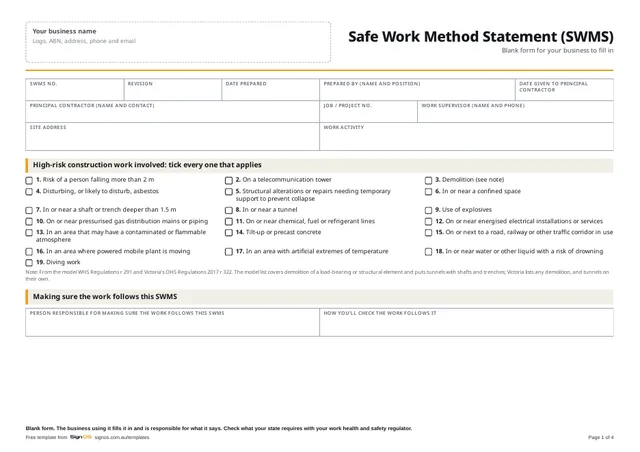
A safe work method statement (SWMS) has to be prepared before high-risk construction work starts, and plenty of sign installs qualify: a risk of falling more than 2 metres, work next to traffic, near powered mobile plant or near energised electrical installations. This form is blank and laid out to what the law says a SWMS must contain. The guide on this page explains each part and where the rules come from. None of it goes into the form: the SWMS has to describe your job, your site and your crew.
Download the free SWMS template
Free to use in your shop, no sign-up. Open the Word or Excel copy to put in your logo and your own wording; the PDF is there to print a blank one.
This is a blank form. Nothing on it is filled in for you: your business writes the hazards, ratings and controls, and is responsible for what it says. The guide on this page is for reading beside it; none of it is in the file. Check what your state requires with your safety regulator.
- Download WordAdd steps, rows and your logo
- Download ExcelTick-box dropdowns, 25 sign-on rows
- Download PDFA4 landscape, 4 pages, ready to print
Sign OS gives each job a SWMS page that fills in the job's details, with a writing guide beside it and the hazards left to you. Try it free for 30 days.
When you need a SWMS
Under the model WHS Regulations, a business carrying out high-risk construction work must make sure a SWMS is prepared before the work starts (regulation 299). Regulation 291 lists what counts as high-risk construction work: 18 kinds, including a risk of a person falling more than 2 metres, work on or near energised electrical installations or services, work on or next to a road or other traffic corridor in use, and work where powered mobile plant is moving. South Australia brought its fall trigger down from 3 metres to 2 on 1 July 2026.
The form's tick list covers all of them, with tunnels on their own line the way Victoria lists them. If a job involves none of them, the law doesn't require a SWMS, though a principal contractor may still ask for one and you still have to manage the risks.
What a SWMS must contain
Regulation 299 says the SWMS must identify the work that is high-risk construction work, state the hazards and risks, describe the control measures, and describe how they'll be put in place, monitored and reviewed. It has to take account of the circumstances at the workplace and be set out so the people using it can readily understand it. Safe Work Australia's information sheet adds that it should be short and focused on the actual hazards and controls: a long, over-detailed SWMS is hard to use on site. The form maps to that:
- The HRCW involved: the tick list, and an HRCW item number against each task step
- The hazards for each step
- The control measures, and how they're put in place
- Who's responsible for each step, and for making sure the work follows the SWMS
- How the controls are monitored and when the SWMS is reviewed, with a review log
- PPE, plant and equipment, licences and competencies, and emergency arrangements
- A sign-on sheet, so the crew record that they've read and understood it
Once it's written
The model regulations then set four rules for using it:
- The work has to be done the way the SWMS says. If it isn't, stop the work as soon as it's safe, and don't restart until it can be (regulation 300).
- On a construction project, give the principal contractor a copy before the high-risk work starts (regulation 301).
- Review it, and revise it if needed, when the controls change (regulation 302).
- Keep it until the work is finished, where the workers and an inspector can get to it, and for at least 2 years if there's a notifiable incident (regulation 303).
Victoria works differently
Victoria hasn't adopted the model WHS laws. Victorian shops work under the Occupational Health and Safety Act 2004 and the OHS Regulations 2017, where the SWMS rules sit in Part 5.1. Regulation 322 lists 19 kinds of high-risk construction work: the same ground as the model list, with tunnels on their own and any demolition included. Regulation 324 says what a SWMS has to do: identify the high-risk work, state its hazards and risks, describe the controls and how they're put in place, and be easy for the people using it to follow. Regulation 327 says you can't do high-risk construction work that puts anyone's health or safety at risk unless a SWMS is prepared before it starts and the work follows it, and the work stops if it doesn't. Regulation 328 says to review it when the work changes or the controls aren't working, including after an incident, and regulation 329 to keep a copy for as long as the work goes on.
WorkSafe Victoria's guidance asks for each task to name the HRCW category, the task, the hazard, the controls and the person responsible, with affected employees and their health and safety representatives consulted while it's prepared. It also says to leave out risk matrices, risk scores and tasks that aren't high-risk construction work, which is why this form has no risk-score columns. WorkSafe Victoria publishes its own SWMS template as well.
How to fill it in
Write it for this job and this site. Safe Work Australia's information sheet points out that a generic SWMS used from site to site may not meet the law unless it's been reviewed for the workplace it's used on.
- Write it with the crew who'll do the work, at the site if you can.
- Break the work into steps in the order they happen, from arriving and setting up to packing up.
- For each step, note the HRCW item number from the tick list, the hazards, the controls and who's responsible.
- Score risks in a risk assessment, not in the SWMS: the SWMS says what the hazards are and how they're controlled.
- Write controls someone can follow: what's done, by whom, with what. "Take care" isn't a control.
- Get everyone to sign on before they start, and again when the SWMS changes.
- Keep it on site, on paper or on a phone, where the crew can get to it.
Choosing controls: the hierarchy
Safe Work Australia's model code of practice, How to manage work health and safety risks, sets out the hierarchy of control measures. Start at the top: eliminate the hazard if you can. If you can't, reduce the risk by substituting something safer, isolating people from the hazard, or using engineering controls. Then use administrative controls, and personal protective equipment last. Admin controls and PPE rely on people getting it right every time, so they back up the higher controls rather than replace them, and a control shouldn't bring in a new hazard of its own.
Victoria runs its own OHS Act 2004 and OHS Regulations 2017 rather than the model WHS laws. For construction work, regulation 325 sets the same order: eliminate the risk so far as is reasonably practicable, then substitute, isolate or use engineering controls, then administrative controls, and PPE last.
On site: things sign shops usually think about
Prompts, not answers. Nothing here has a rating or a control, because whether it applies, how likely it is and what you do about it depends on your job and your site.
- Working at height, and how you get there: EWPs, ladders, scaffold
- Overhead power lines near the work or the lift
- Traffic, pedestrians and the public around the work area
- Roofs, skylights and fragile surfaces
- Working alone, or out of phone contact
In the workshop: things sign shops usually think about
Workshop work usually isn't construction work, so these belong in your risk assessment rather than the SWMS. The same rule applies: prompts only, no ratings or controls.
- Routers and CNC machines
- Lasers, and the fumes they make
- Solvent and UV inks
- Laminator nip points
- Heat guns
- Lifting and handling sheets and panels
- Blades and knives
Who to ask
Safe Work Australia's SWMS information sheet comes with its own free template (Word and PDF), and its interactive SWMS tool walks you through one. Safe Work Australia doesn't enforce the law: your state or territory regulator does, and its site has the rules where you work.
- Safe Work Australia: SWMS information sheet and template
- Safe Work Australia: interactive SWMS tool
- Safe Work Australia: high-risk construction work that needs a SWMS
- Safe Work Australia: model WHS Regulations
- SafeWork NSW (New South Wales)
- WorkSafe Victoria (Victoria)
- Workplace Health and Safety Queensland (Queensland)
- SafeWork SA (South Australia)
- WorkSafe WA (Western Australia)
- WorkSafe Tasmania (Tasmania)
- NT WorkSafe (Northern Territory)
- WorkSafe ACT (Australian Capital Territory)
How Sign OS helps
Every job in Sign OS has a SWMS page for install work, under Site documents on its Dispatch tab. It fills in what it already knows from the job and shows a writing guide beside the form; the hazards, controls, PPE, plant and emergency steps are yours to write. It prints as a branded PDF, and the full SWMS layouts include a worker consultation and sign-off table for the crew to sign. On Scale and above, hazards can link to your own risk register, and the crew's current licences tick the qualification boxes.
Frequently asked questions
- Do I need a SWMS for every install?
- Only where the work is high-risk construction work, and in Victoria where it puts someone's health or safety at risk. A job at ground level with none of the listed work may not need one; work at height usually will. Check the list in your state's regulations, and ask your regulator if you're not sure.
- Can I reuse a SWMS from a previous job?
- As a starting point, yes, but review it against the new site first. Safe Work Australia's information sheet says a generic SWMS may not meet the law unless it's been reviewed for the specific workplace.
- Who keeps the SWMS, and for how long?
- Under the model regulations, keep it until the high-risk work is finished, where workers and an inspector can get to it, and for at least 2 years if there's a notifiable incident. In Victoria, keep a copy for the duration of the work. Your principal contractor may want a copy too.
- Is this form enough to comply?
- No form is. It's blank so you can write a SWMS for your job; your business is responsible for what's in it and for the work following it. Check your state's requirements with your regulator.