
Sign OS blog
What Sign Shop Software Actually Costs
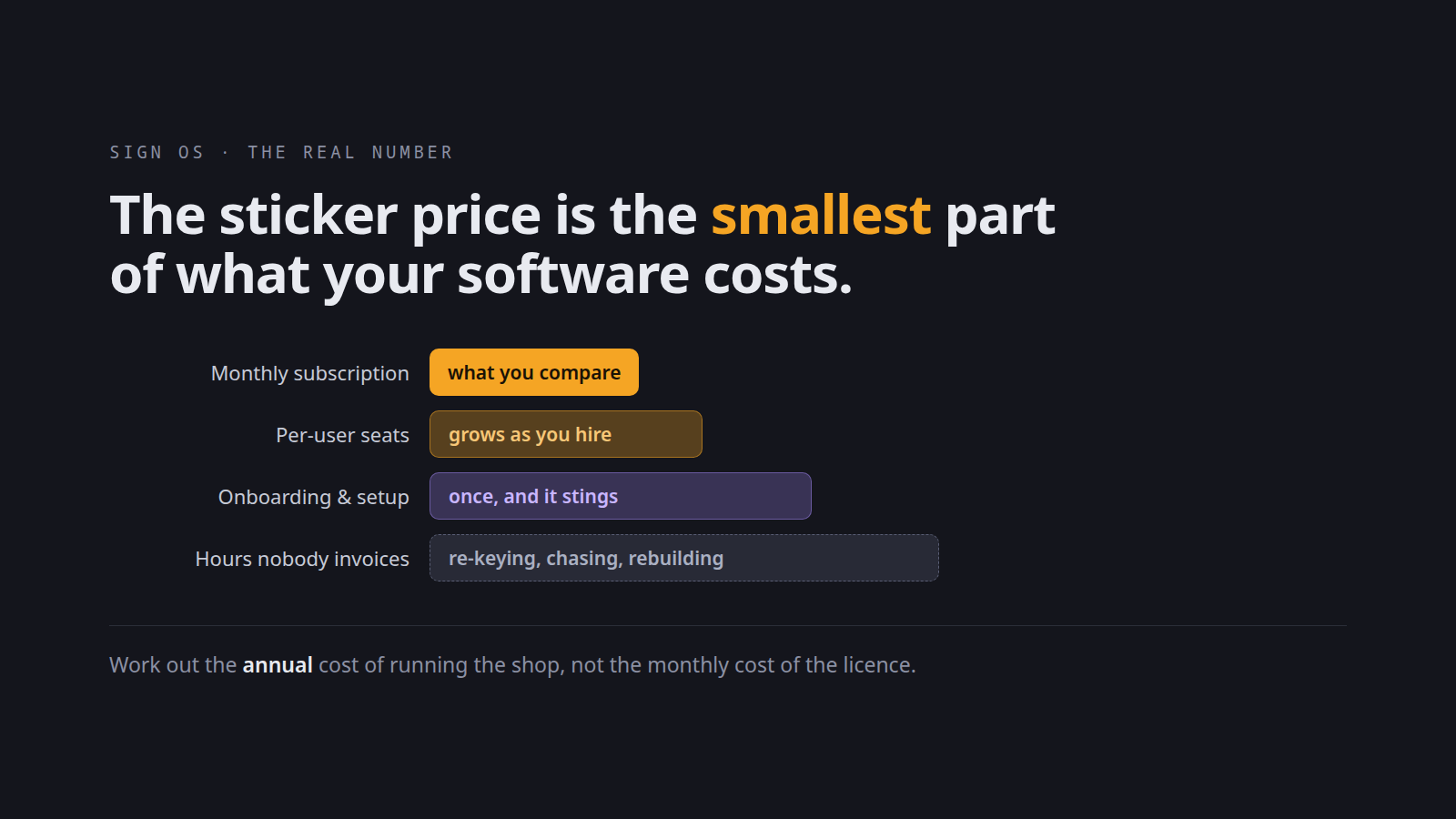
Ask a sign shop what their management software costs and you will get a monthly figure. Ask what it costs to run the shop on it and the conversation gets much longer — and the second number is usually two or three times the first. This is a plain walk through where the difference hides, so you can compare two systems on the number that actually leaves your bank account.
We sell one of these systems, so read this with that in mind. We have tried to write the guide we would want if we were buying rather than selling, and the arithmetic below works the same whichever vendor you point it at — including us.
Start with the seat problem
The single biggest gap between advertised and actual is per-user pricing. A platform at US$99 per user per month looks approachable when you are thinking of yourself and one estimator. Then the production manager needs a login, then the two people on the floor need to see the board, then your bookkeeper wants read access.
You do not get to choose this. If your floor cannot see the schedule, the schedule lives on a whiteboard and you have paid for a system half your shop is not on.
Work it out for the shop you will be in eighteen months, not the shop you are in today:
| Seats | At US$99/user/month | Per year (US) | Roughly, in AUD |
|---|---|---|---|
| 3 | $297/mo | $3,564 | ~$5,500 |
| 6 | $594/mo | $7,128 | ~$11,000 |
| 10 | $990/mo | $11,880 | ~$18,300 |
Those AUD figures are illustrative, at an exchange rate that will have moved by the time you read this — which is itself part of the point. A US-priced platform is a bill that changes with the dollar, and you are absorbing that in a quote you priced three months ago.
The fees that only appear once, and only after you have said yes
Onboarding and implementation fees are normal in this category and often not on the pricing page. Depending on the platform they run from a few hundred dollars to five figures for a guided rollout with data migration.
They are not automatically a rip-off. Moving twenty years of jobs across is genuinely work, and a vendor who does it properly is worth paying. What is unreasonable is finding out about it after you have decided. When you are shortlisting, ask three questions in writing:
- What is the one-off cost to get us live, including data migration?
- What is included in that, and what is billed hourly?
- If we leave in two years, what does it cost to get our data out?
That last one gets the least attention and matters the most. A system you cannot export from is not a subscription, it is a hostage situation — and the price of leaving belongs in the price of arriving.
The costs that are not on any invoice
Here is where most of the money is, and none of it appears on a bill.
Re-keying. Every job that gets typed into a second system is a few minutes plus a chance of a mistake. Ten jobs a day at four minutes is forty minutes, which is somewhere around 160 hours a year. At a loaded labour cost of $58 an hour — a $35 wage with on-costs and realistic productive time — that is roughly $9,300 a year of somebody's life spent copying things.
Chasing. The hours spent finding out where a job is, what was approved, whether the deposit was paid. Nobody logs it, everybody does it.
Remakes. The sign made from the wrong proof version. One reprinted shopfront panel with an install trip is a four-figure mistake, and most shops have a couple a year they have quietly decided not to count.
Underquoting. The slowest and largest of the four. A pricing spreadsheet with a 2023 material cost in it discounts every quote that uses it, and nobody notices because the jobs still look profitable on paper.
You do not need to cost these precisely. You need to stop treating them as zero, because comparing two systems on subscription alone assumes they are.
What the numbers look like side by side
Take a ten-person shop. Illustrative figures, but the shape is what matters:
| Per-seat US platform | Sign OS | |
|---|---|---|
| Licence | ~US$990/mo | A$249/mo |
| Users included | Billed per seat | 20 |
| Onboarding | Commonly $2,000–$10,000 | None |
| Currency | USD, moves with the dollar | AUD, fixed |
| Year one, roughly | A$20,000–$28,000 | A$2,988 |
We have deliberately not named competitors or quoted their prices to the dollar, because published tiers change and half of them are quote-on-request. Get a written quote from whoever you are considering, for the number of people you will actually have, and put it next to ours. That comparison is the one worth doing, and we are happy to lose it on the merits if someone fits your shop better.
Our pricing is on the pricing page in plain numbers: A$89 a month for 3 users, A$169 for 10, A$249 for 20, no per-user fees inside those buckets, no onboarding fee, and paid add-ons listed with their prices rather than hidden behind a call.
Three questions worth asking any vendor
- What is the all-in annual cost for the number of people we will have next year? Not the headline, not per user — the invoice total.
- What do we pay to get our data out? And can we export it ourselves, or must we ask?
- What happens when we grow past this tier? A price that steps sharply at seat eleven is a price you will meet at exactly the moment you can least afford a migration.
None of those are trick questions, and a straight answer to all three tells you more about a vendor than any demo.
Sign OS is sign shop management software built and operated in Australia — quoting, production, purchasing and invoicing on one record, priced in AUD with no per-user or onboarding fees. Every plan starts with a free 7-day trial, and it does not ask for a card. If you are working through this comparison for your own shop, [we are happy to help you do the maths](mailto:[email protected]) even if you end up somewhere else.