
Sign OS blog
Material Yield and Waste: the Substrate Math Behind a Sign Quote
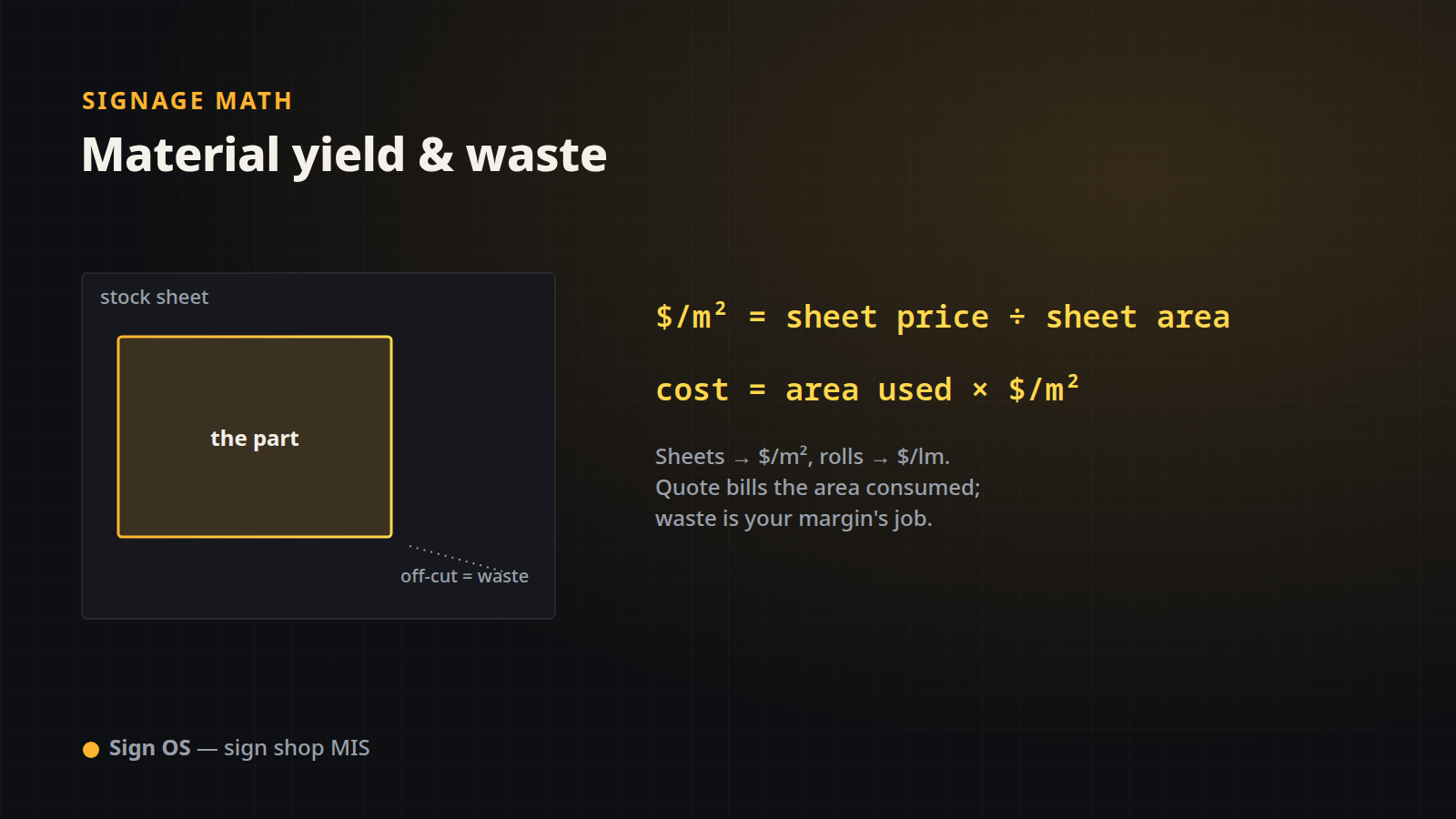
You buy substrate in sheets and vinyl in rolls, but you quote in square metres and linear metres. The bridge between those two worlds — sheet price to per-m² cost, roll price to per-lm cost, and where waste belongs — is where a lot of quotes silently lose money. Here is the exact math Sign OS uses.
Buy in sheets, cost in square metres
Sign OS stores a material the way you actually purchase it, then converts to a unit cost:
sheet area (m²) = (sheet_width_mm × sheet_depth_mm) ÷ 1,000,000
cost per m²     = sheet price ÷ sheet area
material cost   = area used (m²) × cost per m²
Take a 2440 × 1220 ACM sheet that costs $85.00:
| Step | Calculation | Result |
|---|---|---|
| Sheet area | 2440 × 1220 ÷ 1,000,000 | 2.9768 m² |
| Cost per m² | 85.00 ÷ 2.9768 | $28.55 /m² |
| Cost for a 2.88 m² sign | 2.88 × 28.55 | $82.22 |
The 2.88 m² comes straight from the geometry in The Math Behind a Signage Quote — the same area number drives the material line.
Buy in rolls, cost in metres (or square metres)
A roll is the same idea in one or two dimensions. A 1370 mm × 50 m print vinyl roll at $180.00 can be costed two ways depending on how the material is billed:
roll area (m²) = roll_width_m × roll_length_m
cost per lm    = roll price ÷ roll length
cost per m² = roll price ÷ roll area| Basis | Calculation | Rate |
|---|---|---|
| Per linear metre | 180.00 ÷ 50 | $3.60 /lm |
| Per square metre | 180.00 ÷ (1.37 × 50) | $2.63 /m² |
Which one you use depends on how the job consumes the roll — a full-width print bills per m², a cut stripe bills per lm.
How usage scales from the job
Each material line declares how it consumes the sign, and Sign OS reads the matching number from the job's dimensions:
- `sqm` — face area (m²), for print, laminate, substrate.
- `lm` — perimeter in linear metres, for trim, rope, edging.
- `width` / `length` / `height` — a single edge in metres, for a run like a fascia band.
- `each` — a fixed count that ignores dimensions, for a one-per-sign component.
A line can also carry a multiplier — two coats of laminate is the same area billed twice. So a laminate line on our 2.88 m² sign, at two coats, bills 2.88 × 2 = 5.76 m² of film.
Where waste actually lives
Here is the honest part most estimating tools gloss over. Sign OS bills the area you consume at your material's unit cost — it does not silently invent a nesting layout or pad the number with a waste percentage behind your back. That is deliberate: fake precision ("the software said 3.4 sheets") is how quotes drift.
Waste is a pricing decision you stay in control of, and there are two clean ways to handle it:
- Bill the real off-cut. If a 2.88 m² sign has to come off a 2.9768 m² sheet you cannot reuse, quote the area at the sheet's full cost — you paid for the whole sheet, so charge for it.
- Carry it in the margin. Set a material markup that covers your typical yield loss, and let the per-m² cost stay clean. (How markup turns cost into price is covered in Markup vs. Margin.)
Both are defensible. What is not defensible is a black box that guesses. Because Sign OS shows the area, the unit cost and the line total separately, you can always point at exactly why the material costs what it costs.
The payoff
Convert every sheet and roll to a per-m² or per-lm cost once, bill the real area the geometry gives you, and make waste an explicit choice — that is the whole substrate model. Pair it with:
- Machine and Labour Time: How Sign Costing Really Works to add the print, cut and fabrication time.
- Markup vs. Margin to turn the total cost into a price.
Sign OS is the sign shop MIS that keeps material costing honest — real areas, real unit costs, waste on your terms.