
Sign OS blog
From Gantt to Floor: How Sign OS Manages Sign Production from Start to Finish
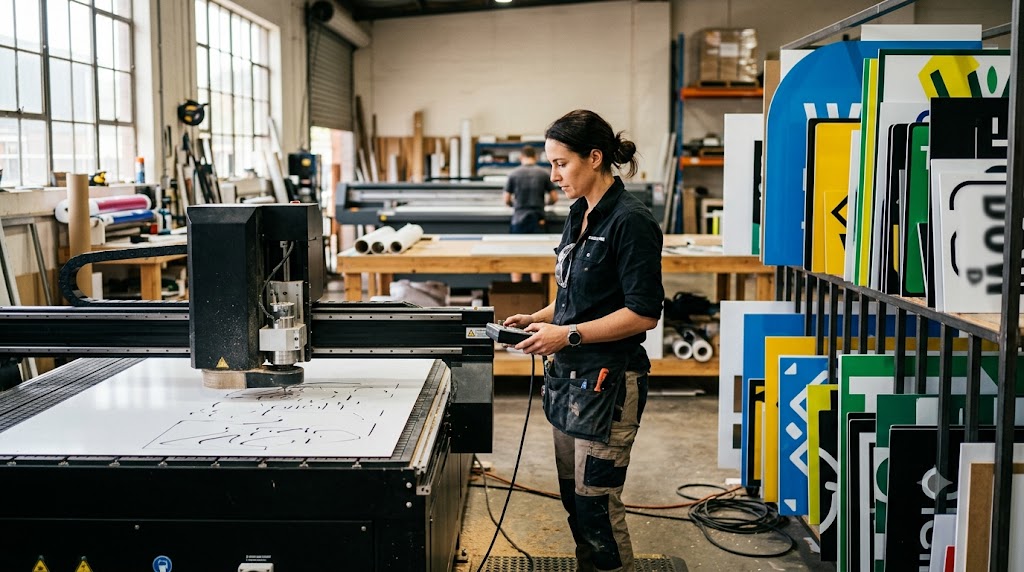
Most sign shops don't have a production system — they have a whiteboard, a group chat, and one person who carries the schedule around in their head. It works until it doesn't: a rush job lands, the whiteboard gets out of date by lunchtime, and the first anyone hears about a blown deadline is the customer chasing it.
Sign OS treats production as one continuous flow: the accepted quote becomes the job, the job gets a computed schedule, the schedule appears on a department Gantt timeline, and the actual work runs on big-button floor boards that update in real time. Here's how each stage actually works.
Quote to job in one click — prices frozen
Production starts before the floor ever sees the work. When a customer accepts a quote, Sign OS creates the job in one click: every line item is copied across as a job item with its pricing and specifications frozen at the moment of acceptance. Nothing is re-keyed, so production never runs off stale or edited numbers.
Each job item carries its production workflow with it. Products in Sign OS are built on process templates — reusable workflows like the steps to print, laminate, trim and pack a run of corflute signs. Each step in a template has a label, an assigned department, and an estimated time in minutes. When the job is created, those steps are snapshotted onto the job, so later edits to the template never disturb work already in progress.
Release to production: scheduling done by arithmetic, not optimism
From the job, you run the Release to production wizard. It checks the job has a due date and process steps defined, then hands the job to the just-in-time scheduling engine.
The scheduler works backwards from the due date. It adds up the estimated minutes on every production step, applies per-department buffer times (a paint department can carry extra buffer for drying, for example), and lays the work into your shop's actual working calendar — your configured working days and hours, minus weekends and Australian public holidays. Every step comes out with a target start and target end time.
That's the difference between a schedule and a wish: the dates on the board are derived from the work the job actually contains.
The Production Timeline: your Gantt view of the whole shop
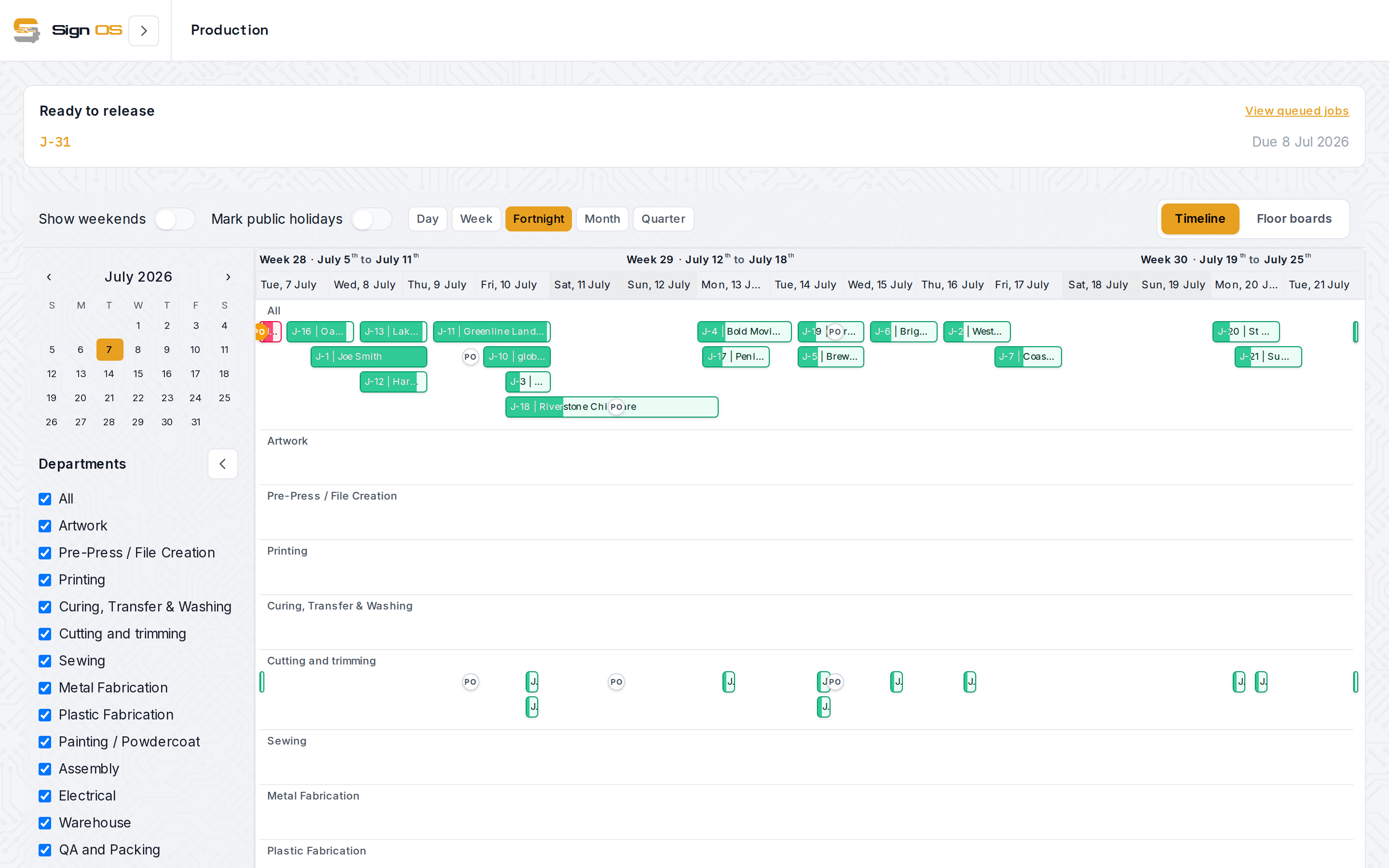
The Production Timeline page shows every released job as a horizontal bar, organised into department rows with an "All" aggregate row on top. You can view it by day, week, fortnight, month or quarter, hide weekends, and overlay public-holiday blockouts.
Each bar tells you three things at a glance:
- Progress — a visual fill showing how many production steps are complete.
- Health — every job is continuously classified as On track, At risk (less time remaining than the work plus buffers) or Critical (less time remaining than the raw labour — it will miss its date if anything slips). You see amber and red before the customer does.
- Purchasing pressure — purchase orders raised against the job appear as markers on the bar at their required-by dates, and overdue POs stand out. Material problems show up on the same timeline as the work they'll block.
Above the timeline, capacity warnings flag departments that are overloaded or nearing capacity for the period, with their utilisation percentage — so you find out the router is booked at 115% next week from the dashboard, not from the queue behind it.
The floor: big buttons, live queue, no prices
Production staff don't work from a Gantt chart. They open the Floor view, which starts with one big card per department showing three live counts: Ready, In progress and Done today. Tap your department and you get a four-column board: Backlog, Ready, In progress, Done.
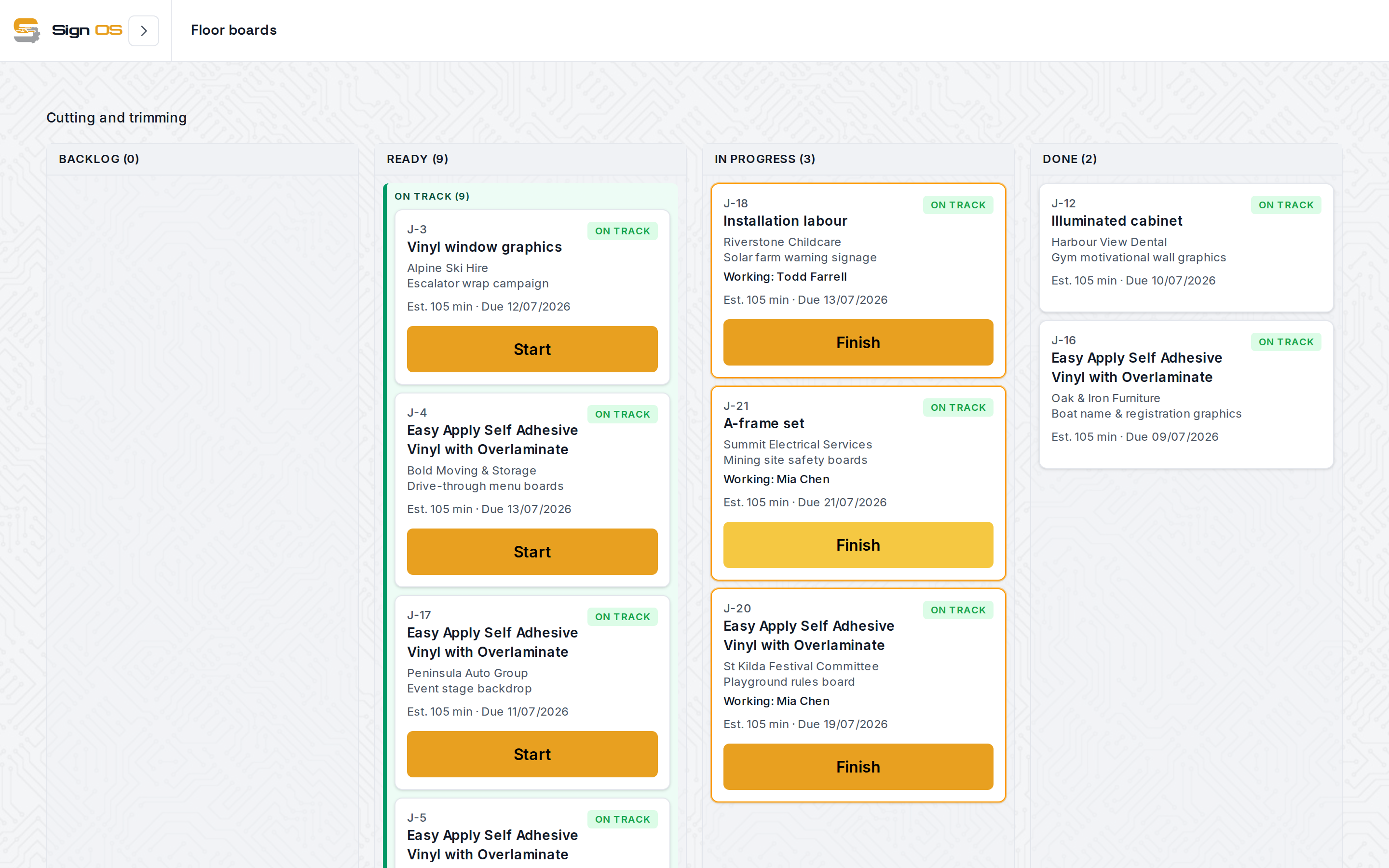
Each card is one production step on one job: the job number, the task, the customer, the estimated minutes and the due date, plus the same on-track / at-risk / critical badge from the timeline. Steps only move into Ready when everything before them is finished — the laminator never starts on a print that hasn't happened.
The interaction is deliberately simple: tap Start and the step is assigned to you with the clock running; tap Finish and the actual minutes are recorded. Cards move across the board in real time as the team works, on every screen in the shop at once. Prices are never shown on the floor.
Every job sheet carries a QR code, so an operator can scan the job on the bench and update the step without navigating anywhere. And because every start and finish is logged with the operator and timestamp, you get a true record of actual time against estimate — which is exactly the data that makes your next quote sharper.
One system, one loop
The point isn't any single screen. It's that the quote, the schedule, the timeline and the floor are the same data: the estimate that priced the job is the estimate that scheduled it, the schedule that placed the bar on the Gantt is the schedule gating the floor board, and the minutes clocked on the floor flow back into the job's health and margins. When production, sales and the front office are looking at the same truth, the whiteboard can finally retire.
Sign OS is built and operated in Australia — AUD plans, GST-aware invoicing, and a free 7-day trial with no card required.