
Sign OS blog
Flexible Quoting for Modern Sign Shops: Standard vs. Custom Items in Sign OS
Sign work splits into two kinds of quoting. There's the work you do every week — corflute runs, ACM panels, vinyl lettering — where speed and consistency win. And there's the work nobody has a template for: the odd substrate, the bespoke fabrication, the "can you do something like this photo?" job. Most quoting tools are good at one and painful at the other.
Sign OS treats them as two first-class item types on the same quote: catalogue items priced from your product recipes, and custom lines built from raw ingredients on the spot. Here's how each works, and why the split matters.
The items step: one line at a time
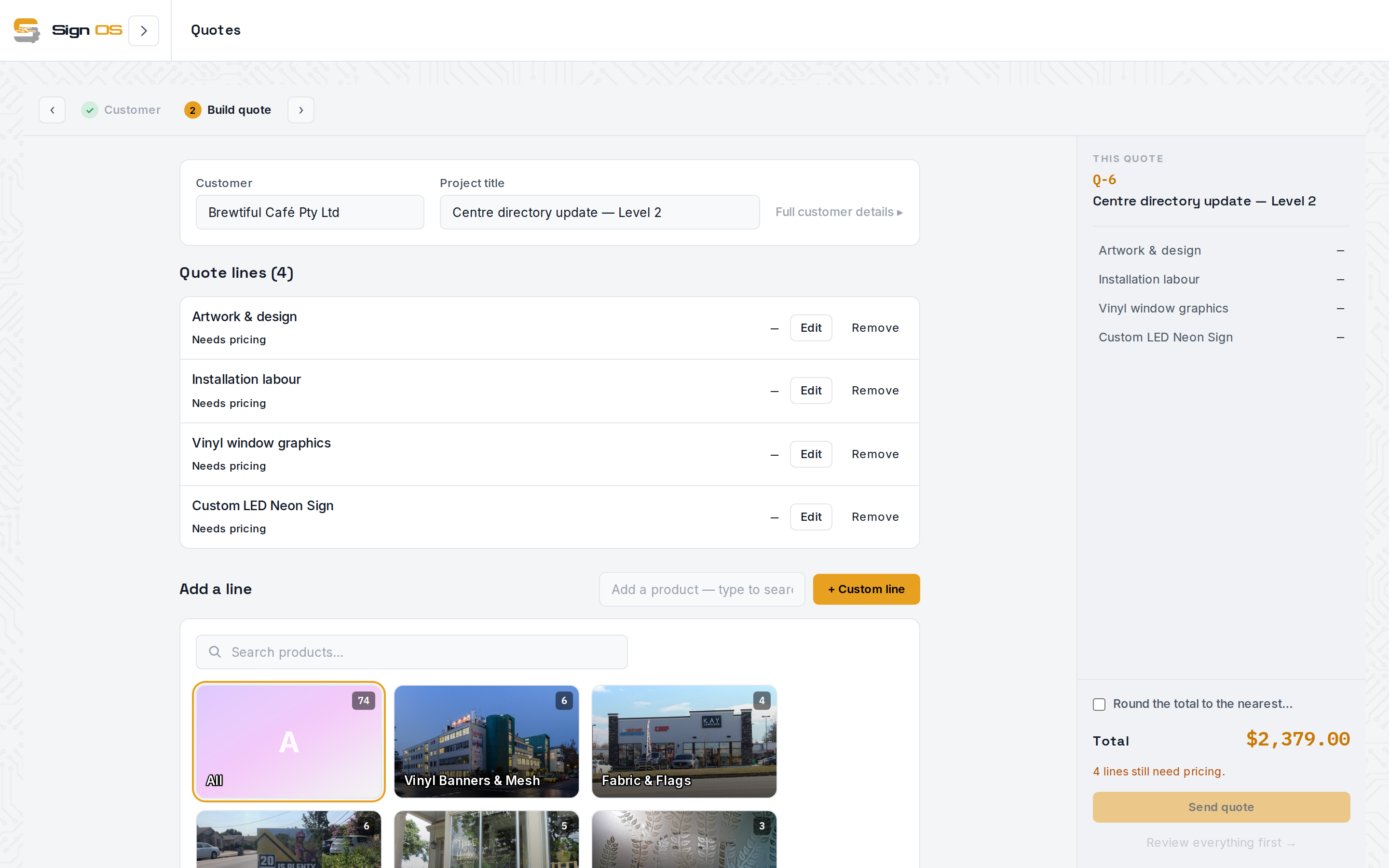
The Sign OS quote builder walks you through customer, items, project logistics and review. On the items step you see your quote as a compact cart of lines, with two ways to add work: Add from catalogue or + Custom line.
Rather than drowning you in a wall of fields, each line opens in its own focused editor — you configure one item at a time, and everything auto-saves in the background as you type. There's no save button to forget and no lost work if the phone rings mid-quote.
Standard items: your catalogue, priced by recipe
Add from catalogue opens a searchable product picker organised by your categories. Every product in it is a recipe your shop defined once: the materials it consumes, the machine processes it runs through, the labour steps, the markup rules, even minimum charges.
Pick a product and the editor asks only for what varies: dimensions (only the ones that product actually uses), quantity, and any product options — laminated or not, single or double sided, whatever the product defines. Options aren't labels; they switch real cost lines in and out of the calculation.
The price is live. The calculation engine runs right in the browser, so every change to a dimension, quantity or option updates the line total instantly — and a Breakdown view shows exactly where the number comes from: material cost, machine cost, labour cost, per unit and per line. A quote your best estimator would take twenty minutes to build from a spreadsheet takes about thirty seconds per line, and prices identically no matter who builds it.
Custom lines: a full recipe, built at quote time
+ Custom line is for the job with no template — and it's deliberately not a "miscellaneous amount" box. A custom line is a real recipe you assemble from five ingredient types:
- Materials — picked from your stock catalogue, with size variants, used per square metre, lineal metre, per piece, or by a dimension of the job.
- Parts & hardware — fixings and components, each or by the pack.
- Labour — by department, at your hourly rates (create a department inline if you need to), charged by time, by speed (say, 15 minutes per square metre) or per unit, with setup time included or not.
- Machine time — from your equipment profiles, time-based or per-unit.
- Fixed fees — a delivery charge, a permit, anything flat.
Every line carries its own margin percentage, so a risky material can carry more protection than routine labour on the same item. And because dimensions drive the usage maths, entering the job's width and length auto-populates material quantities the same way a catalogue product would.
The same live engine prices it as you build: total cost, total sell, per-unit price, with warnings if something's missing. One more useful touch — a custom line has separate quote description and job description fields, so the customer reads a clean sales description while the floor gets the technical one.
From draft to job, with the price locked
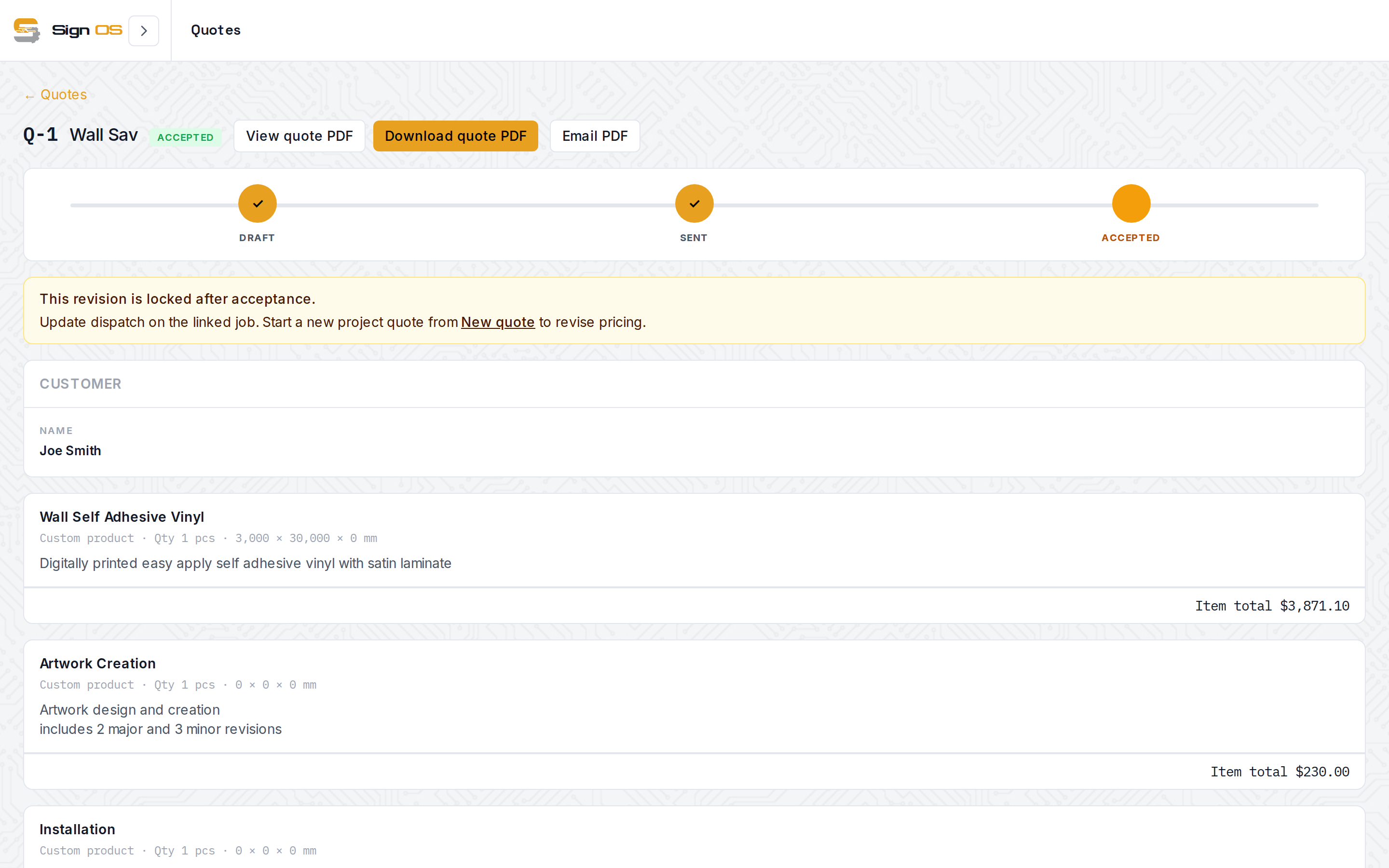
However the lines were built, the quote lifecycle is the same. Drafts stay editable; sending can be gated through an approvals inbox if your shop enables that policy, so a manager signs off before anything reaches the customer. On send, the customer gets a branded PDF with line items, dimensions, GST and totals — and the pricing snapshot is locked. Need to change something later? Create a revision: Sign OS clones the quote into a new draft and keeps the whole revision thread together.
When the customer accepts, the quote becomes a job in one click, and every item — catalogue or custom — is snapshotted onto the job with its pricing and specs frozen. Production runs from exactly what was sold.
Why the split matters
A catalogue-only system forces you to fake one-off work through the nearest template and hand-fudge the price. A free-form-only system makes every repeat job a fresh estimate and every estimator a different price list. Running both on one quote — the repeatable work priced by recipe, the exceptions built ingredient-by-ingredient with the same live engine underneath — is what lets a modern sign shop quote fast and quote defensibly, on the same document.
Sign OS is built and operated in Australia — AUD plans, GST-aware quoting and invoicing, and a free 7-day trial with no card required.